Our Inner Fire: The Yogic Teaching of Tapas for a More Aligned Life
By Anna Caldwell - Yoga, Sound Healing & Meditation Online and Mallorca, Spain
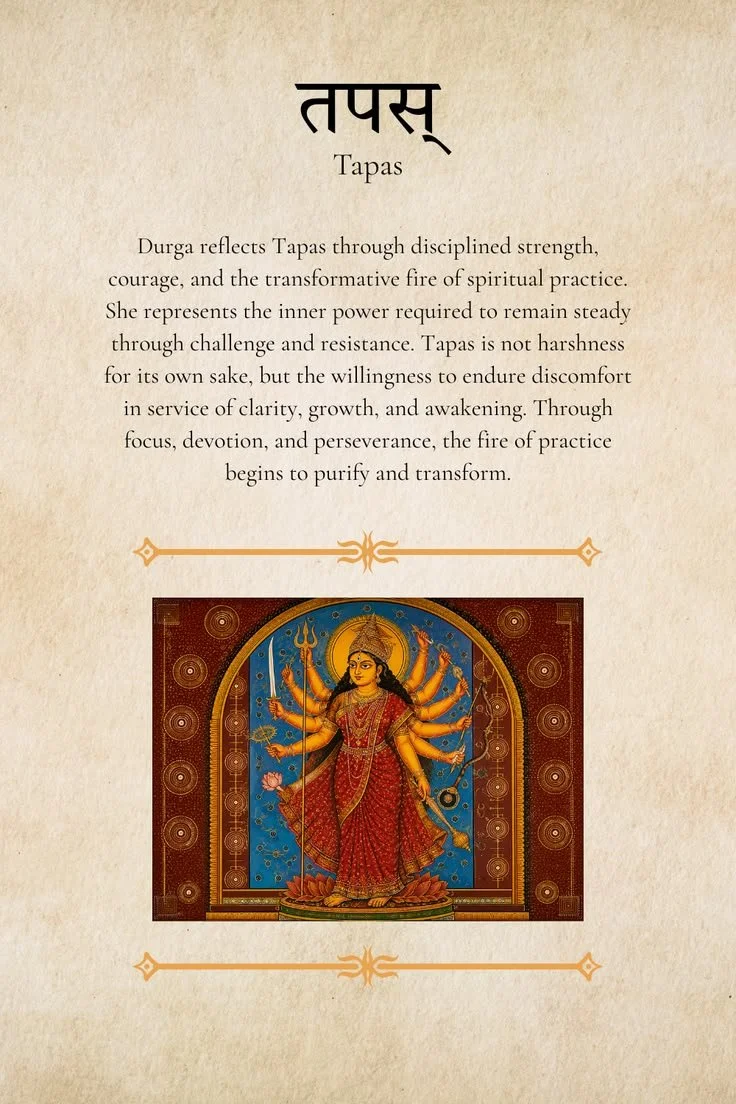
There is a fire within us that has nothing to do with motivation or willpower as the modern world understands them. This concept stems from the yogic tradition and is called tapas - our inner fire of self-discipline, transformation and concerted effort that, ultimately, burns away what is no longer true or aligned with us.
Tap — to heat. To glow. To burn.
From this single Sanskrit root comes one of the most profound teachings in all of yogic philosophy: that transformation (or yoga as we understand it!) is not gentle nor is it always comfortable. The path of awakening is one of uncovering our true nature and, according to this lineage, is a path that puts us straight into the fire.
The Roots of Tapas
Tapas is one of the oldest concepts in the Vedic tradition. It appears throughout the Rigveda (the most ancient of the four Vedic texts) as the creative heat through which the cosmos itself was born. The ancient rishis (seers) understood Tapas as the primal generative force underlying all of existence. The world was forged in fire. So, too, is the self! In the Mahabharata, one of the great epics of Indian civilisation, Tapas is woven throughout the stories of sages and warriors who retreat into periods of intense practice (that could like like fasting, meditation, austerity, etc.), in order to cultivate spiritual power and clarity. Arjuna, the great warrior, retreats to the forest to perform Tapas before the great battle to purify himself enough to be worthy of the divine knowledge that Shiva would ultimately bestow.
The teaching is consistent across the ancient texts: Tapas is not about punishment or deprivation. It is about purification and cultivating a self-discipline that ultimately allows us to have more freedom and energy in our lives. The body subjected to Tapas is the vessel. The ego, the attachments, the conditioning — these are the fuel. What remains after the fire, if Tapas is performed rightly, is not a more powerful ego but a purified consciousness capable of receiving what the tradition calls Brahman-knowledge — the direct knowing of one's true nature.
Tapas in the Yoga Sutras
Patanjali's Yoga Sutras were composed roughly two thousand years ago and are still one of the most precise and practiced maps of the inner life available in the world of yoga. We see the mention of Tapas at the very beginning of the second chapter, in the first sutra:
Tapah svadhyaya ishvarapranidhana kriya yogah (PYS 2.1)
Tapas, self-study (Svadhyaya), and surrender to something greater than ourselves (Ishvara Pranidhana) together form Kriya Yoga — the yoga of action. These practices help us work with the obstacles that cloud our perception and make it difficult to recognise our true nature. Tapas appears again as the third of the five Niyamas, the personal observances that form the second limb of the eight-limbed path. Alongside Shaucha (cleanliness), Santosha (contentment), Svadhyaya (self-study), and Ishvara Pranidhana (surrender), it invites us to consider how we relate to ourselves. For me, this includes learning to recognise when effort is needed and how to offer it with care. There is discipline here, but also patience: a willingness to return to practice, remembering why we began.
All that to say, is that we do not need to practice yoga to perhaps recognize areas in our life where we feel the desire to change but often lack energy to move forward with that change. This could look like carving more time out for ourselves during the day, changing an undesired habit, adding a new habit, begin something new, etc. This is where our Tapas comes into our everyday life…exploring what helps us follow through on the things that matter to us, especially when enthusiasm fades. How can we show up for ourselves with commitment and care?
Tapas and the Samskaras
In yogic philosophy, Samskaras are the deep grooves of habit and conditioning encoded in our subconscious mind … i.e. the patterns laid down by repeated thought, action,and experience that run beneath the surface of conscious awareness and shape how we respond to the world.
We all have these grooves … the tendency to reach for comfort when discomfort arises or the impulse to avoid the difficult conversation. This can also look like a habit of shrinking rather than following our passion/authenticity or the pattern of seeking validation from external sources. In many ways, this subconscious wiring creates allllll of the stories we tell about who we are and what we are capable of. We keep coming back to this idea of tension or friction … and tapas is the practice that creates that friction necessary to interrupt these grooves. Each act of Tapas creates what the tradition calls samskara virodha: the counter-impression or the new groove. This, too, is neuroplasticity at play. By choosing, again and again, something different we rebuild ourselves on a mind (truly, brain cell by brain cell!), body and spirit level.
Three Kinds of Tapas
The Bhagavad Gita, a central text in the yoga tradition, explores how we might live and act with greater awareness. It takes the form of a conversation between the warrior Arjuna and his guide, Krishna, as he faces a difficult decision and although its setting is a battlefield, many of its questions are familiar: how do we know what to do, and how do we act when we feel afraid, uncertain, or torn? These are the questions that arise in our own personal battles in the field of our consciousness.
The Gita explores Tapas through three dimensions (body, speech, and mind), reminding us that practice includes how we act, how we speak to others, and how we relate to our own thoughts. It also describes how Tapas can be influenced by the three Gunas. These are qualities that, in yoga philosophy, run through nature and shape our experience: Sattva, associated with clarity and balance; Rajas, with activity and restlessness; and Tamas, with inertia and heaviness. We all experience these qualities in different combinations. You might recognize them in moments when you feel clear and settled, when your mind races, or when getting started feels difficult.
Through this lens, Tapas asks us to look at the intention behind our effort. Are we practicing with steadiness and care, seeking praise or recognition or pushing ourselves in ways that cause harm? The same outward action can come from very different places.
Sattvic Tapas (the highest form) is practiced without attachment to outcomes. It is done as an act of devotion, purification and a deep love for the practice itself. We practice and act not to receive benefits but to grow our heart.
Rajasic Tapas is driven by desire — for recognition, for power, for specific results. It can produce tremendous energy, but it keeps the practitioner bound to the ego's agenda rather than freeing them from it.
Tamasic Tapas arises from confusion or self-punishment — austerity that depletes rather than transforms, effort that harms rather than purifies.
I love one of the descriptions for illuminating the teachings of Tapas as the metalworker and gold. When working with these elements, the goldsmith does not get angry or hate the raw ore and, instead, continually applies heat in a way that does not damage the substance, but rather illuminates what has always been the potential. The fire is not meant to burn in this case but simply to be the elemental condition of revelation. What this means in the context of modern life is that we should not undertake a discipline from a place of self-rejection or self-hatred or the belief that we are not enough just the way we are - this is not Tapas in the yogic sense. True Tapas arrises out of a love for ourselves to become better and better and to serve those in our life with clarity and love. True Tapas arises when we see clearly certain patterns and habits of ours keep us from being what we most deeply are. And this love, whether for our practice, for our path or for our search for truth … makes any friction that shows up along this path truly the ethos of yogic Tapas.
