The Gong: History, Power & the Art of Playing
By Anna Caldwell - Yoga, Sound Healing & Meditation Online and Mallorca, Spain
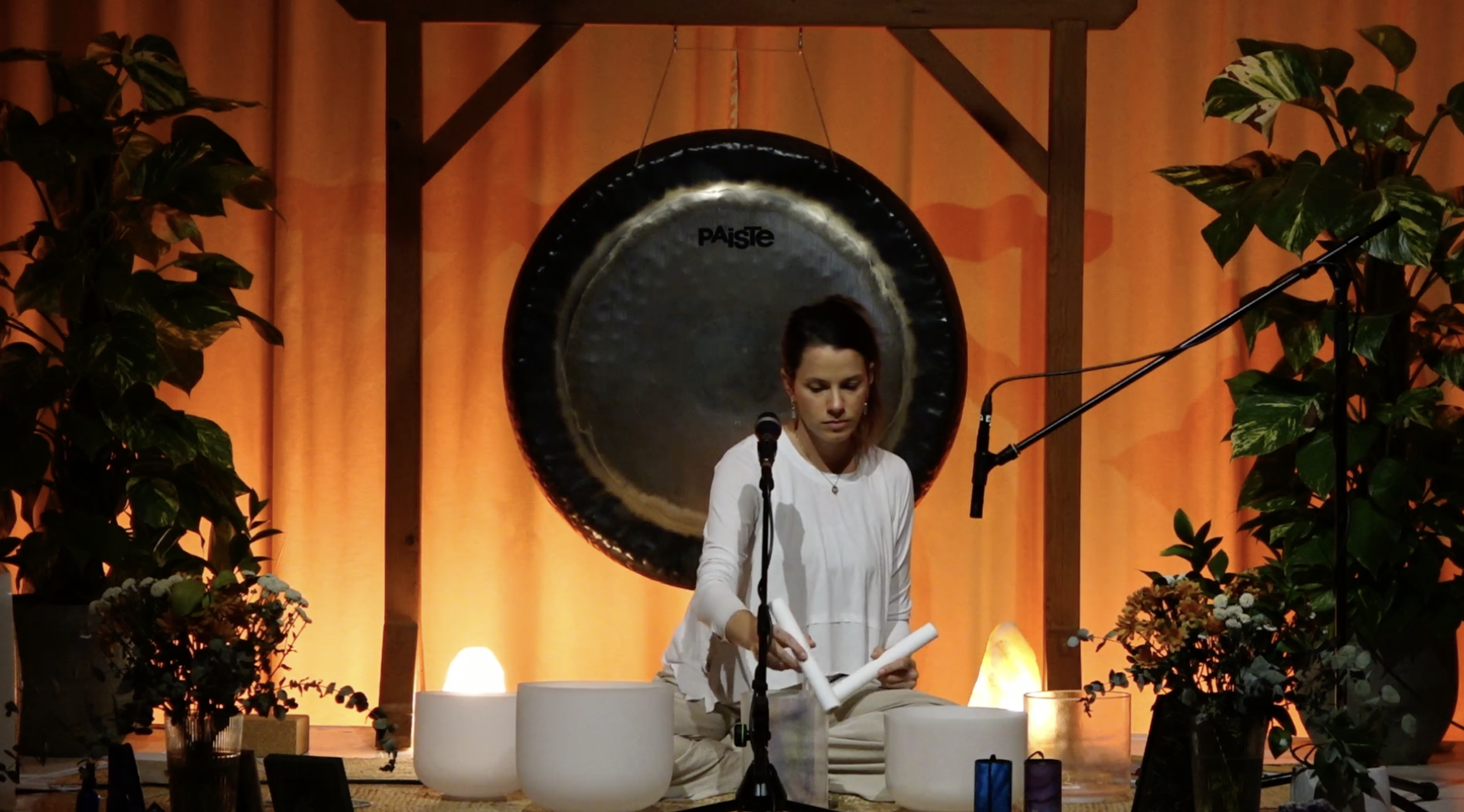
Lately, I have had many students interested in the power of the gong and how, in a sound bath session, this is the instrument that either puts them straight to sleep or on a (sometimes wild!) inner journey through thoughts, emotions, memories and even very real somatic reactions such as temperature changes, shaking, tingling or pressure in different areas of the body. As far as sound healing as an art is concerned, the gong is actually one of the most ancient instruments we have.
“those who play the gong, know the secrets of the Universe”
The gong is one of the oldest instruments on earth. Its origins trace back to the Bronze Age civilizations of Central Asia (as far back as 3500 BC) where it was used in rituals, ceremonies, and as a signal instrument in battle. The earliest recorded evidence of gong culture spans Burma, China, Java and what is now Vietnam, where the instrument held a place of deep cultural and spiritual significance.
Ancient Chinese culture used gongs to announce the arrival of dignitaries and to open sacred ceremonies. In Buddhist temples across Southeast Asia, gongs marked the beginning and end of meditation, we like to think of this as a signal not just of time, but of transition, of entering and leaving a different quality of awareness. In Indonesia, the gong became central to the gamelan orchestra, providing the metric anchor around which entire ensembles structured their sound.
The gong travelled westward along the Silk Road in the 16th century, arriving in Europe where its extraordinary volume and range made it useful as a warning signal — for fires, for gatherings, for moments when an ordinary sound simply would not do. It entered Western orchestral music in the 18th century, where composers discovered that no other instrument could produce the same quality of drama, depth, and suspended time.
By the time the gong arrived in modern sound healing spaces, it had already travelled five thousand years. Every tradition it passed through found it the same thing: an instrument unlike any other.
Why the Gong is So Powerful
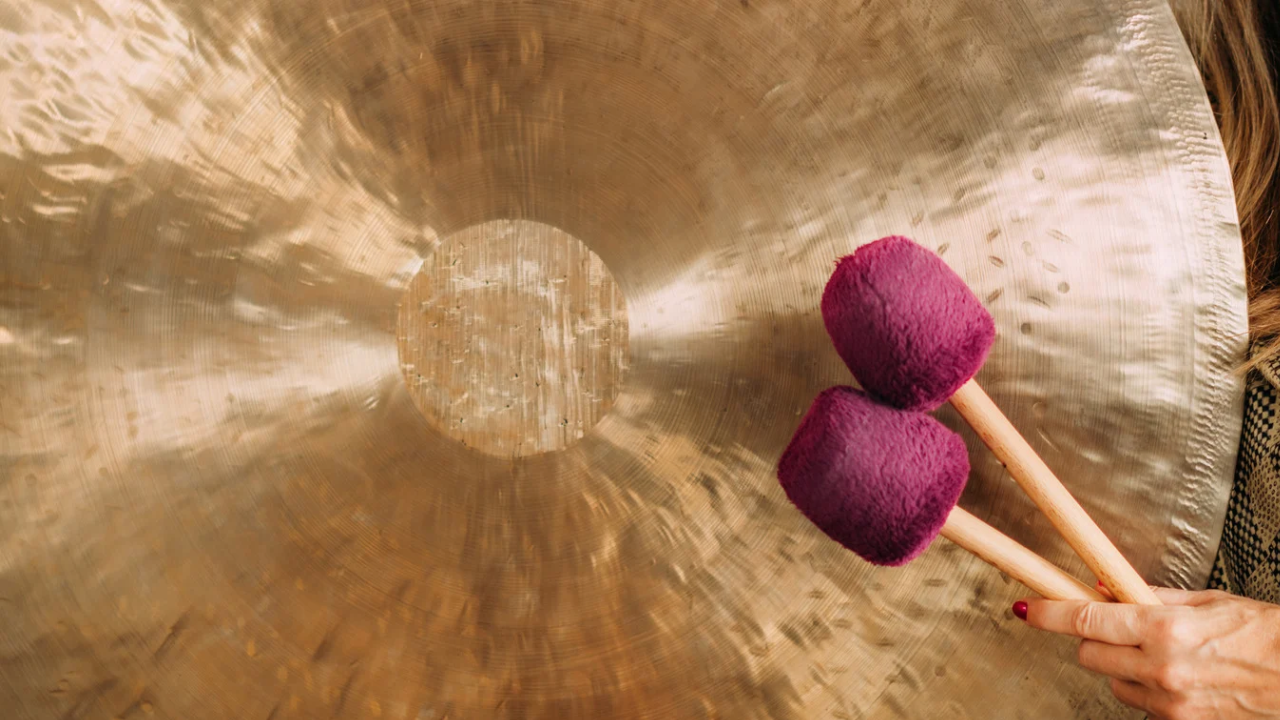
A single strike of a gong produces hundreds of frequencies simultaneously, a vast, layered, shifting acoustic field that continues to evolve long after the initial impact (we call this the decay). The sound is always in motion and continues to reveal new layers. What makes this so uniquely effective in a healing context is due to the fact that the sound never settles into a predictable pattern, the analytical mind (which is accustomed to identifying, categorizing, and anticipating what it hears) finds no foothold. It cannot follow the gong. And so, eventually with time and consistency, the mind stops trying.
When this happens, our nervous system stops organizing itself around our mental activity and begins to move into a more relaxed state. On a brain level, this is when our waves move from faster beta waves into creative, more gentle alpha waves. Given time and surrender, we may even slip into theta: the brain activity of deep, meditative states and even where we hover around the threshold between waking and sleep. This is where emotional integration, creative insight and restoration becomes possible. It sounds complex (because the biology of course is!) but really what it means is this: when our body and mind are relaxed, we have more energy available to devote to the bodies inherent healing and regenerative capacities.
Types of Gongs
The family of instruments that falls under this name “gong” is vast and varied, and each type carries its own character, its own range of sound, and its own role in practice.
The Symphonic Gong (also called a Tam-Tam) is the most widely used in sound healing. It has a flat surface and produces an enormous landscape of harmonics. It is unpitched in the traditional sense, meaning it does not emphasize a single defined note but rather fills the room with a full spectrum of frequencies that shift and evolve with each strike. This is the gong that creates those oceanic, immersive waves of sound most people associate with a gong bath. I love using this type of gong, because it fits in seamlessly with almost all my other intstruments.
The Chau Gong (originating in China) has a distinctive turned-down rim and a slightly bossed centre, producing a sound that builds dramatically from a low fundamental into a crashing wave of overtones. It is deeply powerful and often the gong that people feel in the chest.
The Wind Gong — thin, flat, and highly responsive, opens quickly and brightly. It speaks in higher, more ethereal frequencies and responds to even the gentlest touch. Its sound is immediate, bright, and carries a quality of clearance … I love this gong for the power that can come out of it, even with smaller gongs and there are so many different ways to create sounds out of it!
Planetary Gongs are modern instruments tuned to the calculated frequencies associated with the planets in our solar system — frequencies first explored by Pythagoras in his concept of the Music of the Spheres, and later calculated by the Swiss mathematician Hans Cousto. Each planetary gong carries the frequency of a celestial body: the Earth, the Moon, the Sun, Mars, Venus, and so on. In practice, each one is said to evoke a different energetic quality (grounding, clarifying, expansive, activating, etc) and practitioners often choose a gong intuitively based on the intention of the session. I use the 36in Earth Gong from Meinl Sonic Energy in my Sound Baths. It is deep and grounding!
The Art of Playing
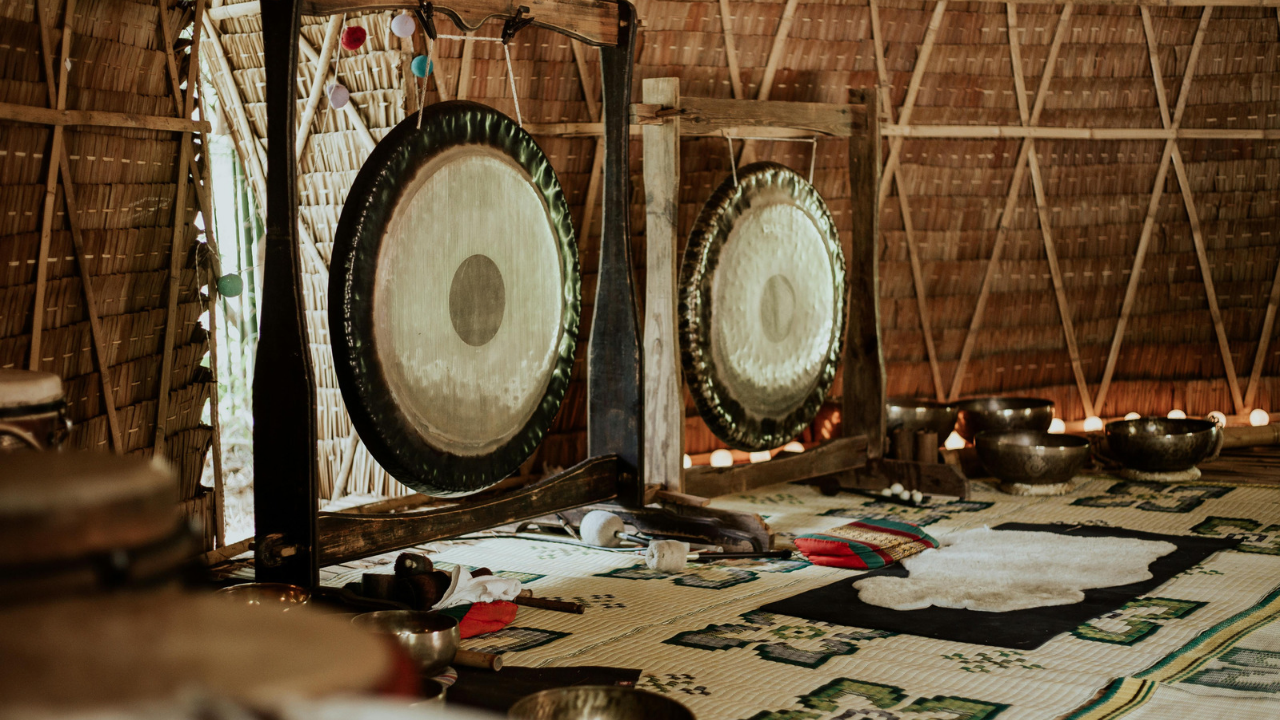
What surprises most people when they begin learning the gong is how much is possible with a single instrument. We have a saying in the sound healing world … you don’t need another gong, you need different mallets and more ways to play! The gong has a geography. Each area of its surface produces a different quality of sound, and learning to navigate that geography is one of the foundational arts of gong playing.
The center holds the lowest, deepest frequencies, the fundamental tone, the voice that moves through the floor and is felt in the body before it is heard by the ears. Striking here with a soft, woolly mallet produces the characteristic bloom of the gong: a sound that swells in volume after the initial contact, building like a wave before it crests and begins its long, gradual decay. We don’t always play this area depending on which type of gong. In general, it is an area I avoid for symphonic gongs, tam tams or planetary gongs….some teachers even say it is cursed to hit this area! I say, explore your own way and feel the sound in your body ;)
The middle ring (between centre and rim) is where the overtones live. This is where the gong's complexity unfolds, where the higher harmonics layer themselves into the sound and the full richness of the instrument begins to reveal itself.
The rim has higher, brighter, almost bell-like. A precise strike at the edge of the gong cuts through the sonic landscape with crystalline clarity. Many traditions associate this sound with moments of awakening or transition. Again, this is not an area we play in all gongs depending on the type. In fact, depending on which gong you are playing, it is an area to absolutely avoid, as it could change the tuning of the gong.
Beyond the striking point, the mallet itself changes everything. A soft wool or fleece mallet draws out warm, blooming tones with gentle crescendos and few high overtones. A felt or medium mallet offers balance. A harder mallet brings sharper, brighter tones and more pronounced harmonics. And a friction mallet (a specialized tool dragged across the surface rather than struck) produces something else entirely: a sustained, ethereal, almost vocal tone, sometimes even sounding like whale song. A skilled gong player learns to read the instrument in the moment, to listen to what the room needs, what the listeners need (and how they are responding), what the gong itself is offering … and to move between these different techniques intuitively, guiding the sound rather than forcing it.
As one practitioner beautifully described it:
playing the gong is not hitting an object. It is beginning a conversation with a living instrument.
I offer Sound Healing Trainings in Mallorca that include in-depth work with the gong: its history, its techniques, its role in a full sound healing practice, and the art of holding space for others through sound. These are immersive, embodied containers for those who want to go beyond the surface and into the real depth of this work.
